




How AI Actually Reads Your Search When You Shop for Home Improvement Products
SlickPurchase
Sep 16, 2026
The Search Bar Isn't Neutral
You type "primer for bathroom walls" and hit Enter. A list of products appears. Feels straightforward, right? It's not — not even close. What happens between your keystrokes and those results is a chain of AI-driven decisions that weighs dozens of signals at once, and if your search term is even slightly ambiguous, the algorithm makes a judgment call you never agreed to.
For most product categories — phone cases, coffee mugs, socks — that judgment call rarely costs you. But home improvement is different. The wrong primer, the wrong sealant, the wrong adhesive, and you're either repainting in six months or making a hardware store run you didn't budget for. Understanding how AI reads your search isn't a tech deep-dive for its own sake. It's practical knowledge that saves you a wasted afternoon.
What AI Is Actually Doing When You Search
Modern e-commerce search engines don't do simple keyword matching anymore. They use natural language processing (NLP) — a branch of AI that tries to understand the intent behind words, not just the words themselves. When you type a phrase, the system breaks it into components: the product type, the use case, the surface or environment, and any modifier words like "fast-drying" or "no-sand."
Then it tries to fill in what you left unstated. "Primer for bathroom walls" tells the AI: category = primer, location = bathroom, surface = walls. But it doesn't tell the AI whether you're painting new drywall, covering a water stain, or going over glossy tile. So the algorithm falls back on what most people buying that phrase probably wanted — and "most people" is a statistical average, not you specifically.
This is where the mismatch happens. You needed a stain-blocking, mold-resistant primer for a humid bathroom with an old water stain. The AI surfaced a general interior primer because that's what the broadest slice of "bathroom wall primer" searchers historically clicked on.
Why Ambiguous Queries Produce Generic Results
Search AI is trained on behavior data: what people searched, what they clicked, what they bought. When a query is vague, the model hedges toward the most-clicked result for that phrase — which tends to be the most popular, most reviewed, most broadly applicable product in that category. Popular isn't wrong. But popular is rarely the most specific match for your actual situation.
There's also a ranking layer that factors in product title keywords, bullet points, and descriptions. A product that says "interior primer" in its title will rank for "bathroom primer" even if a product that says "mold-resistant stain-blocking primer for humid environments" is technically the better fit — because your search didn't include those words, so the AI didn't weight them heavily.
The result: general-purpose products float to the top of ambiguous searches, and specialized products get buried unless you know the vocabulary to surface them.
The Vocabulary Gap Is the Real Problem
Here's the thing most guides skip. AI search engines in retail are trained on product catalog language — the words manufacturers and sellers use. Your search is written in everyday language. Those two vocabularies don't always overlap.
You say "won't peel off glossy surface." The catalog says "exceptional adhesion to glossy enamels without sanding." You say "covers rust stains on metal." The catalog says "rust inhibitive, blocks tannin and grease stains." The AI bridges this gap using semantic similarity models, but it's imperfect — especially when your phrase contains a word that's common across many product types (like "primer," which appears in paint, skincare, and makeup categories alike).
In a large multi-category store, that cross-category ambiguity is a real factor. Search "primer" with no modifier in a store that carries both paint and beauty products and the AI has to make a call based on your browsing history, your location in the site, and the overall click patterns for that word. Sometimes it guesses right. Sometimes you end up looking at foundation makeup when you wanted wall primer.
How to Search Smarter: Speak the Catalog's Language
You don't need to know every technical term. You just need to add a few more specific words to your search. Here's what actually moves the needle:
- Name the surface, not just the room. "Bathroom walls" is vague. "Drywall," "tile," "plaster," or "concrete block" are surfaces — and those words appear in product specs. Use them.
- Name the problem you're solving. If there's a stain, say "stain blocking." If there's rust, say "rust inhibitive." If the surface is glossy and you don't want to sand, say "no sand" or "bonds to glossy." These are the exact phrases that live in product titles and bullets.
- Add the application environment. "High humidity," "exterior," "interior," "mold resistant" — these filter out products that aren't rated for your conditions. A primer designed for dry interior walls isn't the same product as one engineered for a bathroom or laundry room.
- Include the base type if you know it. "Water-based primer" and "oil-based primer" return completely different product sets. If you're painting over latex paint, water-based matters. If you're blocking heavy stains or working with shellac, that distinction matters even more.
- Avoid category-crossing words alone. Single words like "primer," "sealer," or "base" are too broad in a multi-category store. Always pair them with a surface or use-case modifier.
A Real Example: What Changes When You Search Better
Take a common scenario: you're repainting a bathroom that has a yellowish water stain on the ceiling and glossy enamel paint on the walls. You need one primer that can handle both.
Search: "primer" → you'll likely get a mix of paint primers and possibly beauty products, ranked by popularity.
Search: "primer for bathroom" → better, but still broad. Results will lean toward interior wall primers generically.
Search: "water based stain blocking primer glossy surface no sanding" → now the AI has four specific signals to work with, and the results narrow dramatically toward products actually built for your situation.
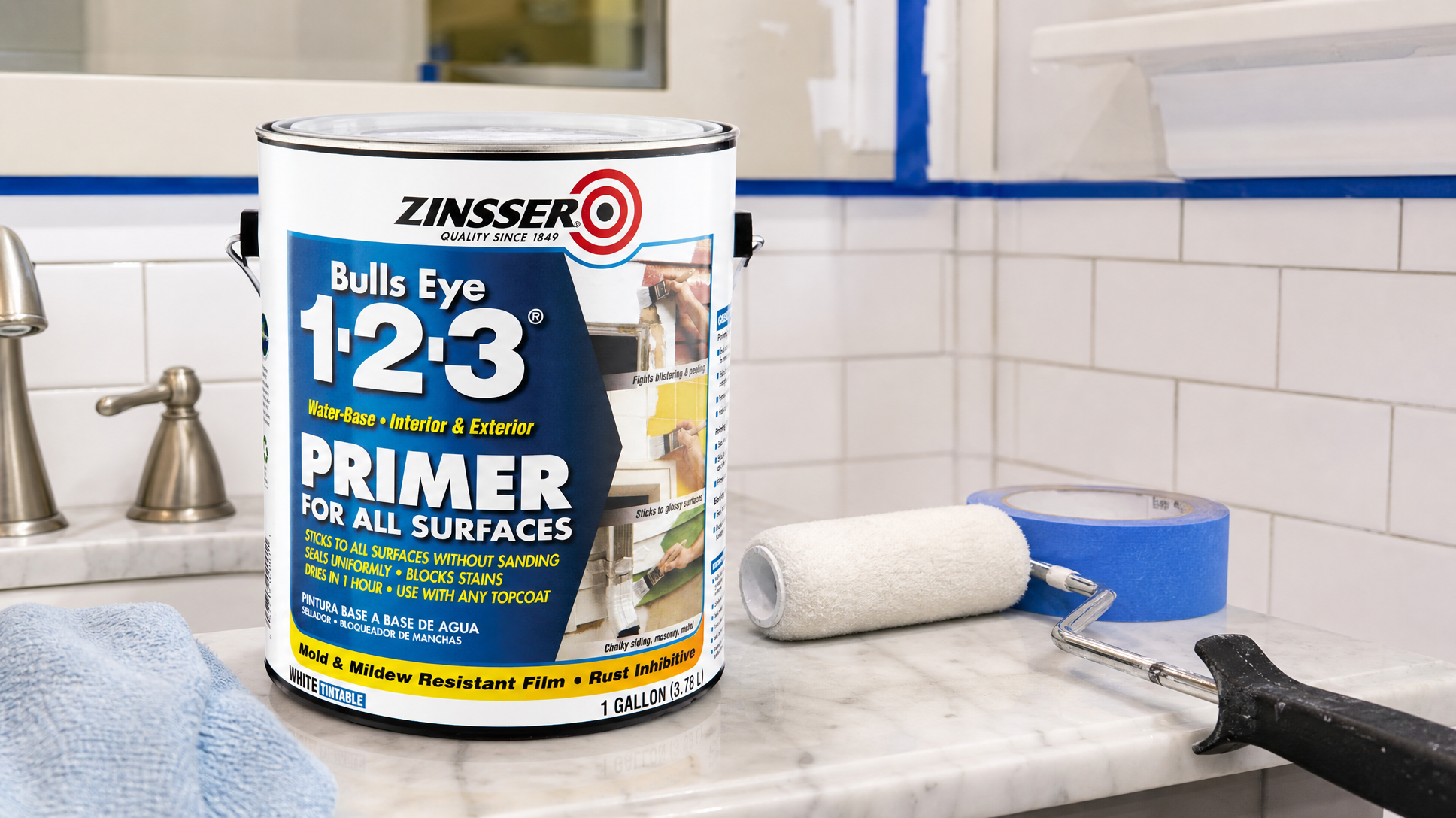
That last search is what surfaces something like the Zinsser Bulls Eye 1-2-3 — a water-based primer that sticks to glossy surfaces without sanding, blocks stains including water stains and grease, and is specifically suited for humid environments like bathrooms. It's also rated for both interior and exterior use, so one can handles your ceiling, your walls, and any exterior trim you tackle later. The product was always in the catalog. The vague search just never found it.
One More Thing: Filters Are Underused
Most shoppers type a search term, scroll the first page, and give up if nothing looks right. The filter panel — surface type, formula, indoor/outdoor, brand — is where you recover from a broad search. After your initial query, use filters to narrow by the attributes that matter most to your project. AI search gets you into the right neighborhood; filters get you to the right house.
It's also worth reading the product description rather than just the title. AI ranks products partly on title-keyword match, which means a product with a vague title but a detailed, accurate description might rank lower than it deserves. The description is where you'll find the actual use cases — surfaces it sticks to, stains it blocks, environments it's rated for. That's the information that determines whether a product actually solves your problem.
The Takeaway
AI search is genuinely impressive at interpreting intent — but it's working with the words you give it. Give it vague words, get average results. Give it specific, catalog-aligned words, and it surfaces the product that was built for your exact job. That's not a workaround; it's just how the technology works.
Next time you're shopping for home improvement supplies, spend ten extra seconds on your search term. Name the surface. Name the problem. Name the environment. The right product is almost certainly already there — the search just needs enough signal to find it.
Ready to put it into practice? Browse Tools & Home Improvement at SlickPurchase and try a specific, surface-and-problem search — you might be surprised how quickly the right product shows up. And if you want to see how shopping smarter across categories saves you time and money overall, this guide breaks it down.
Frequently Asked Questions
Why does searching a product category sometimes return results from a completely different department?
In a large multi-category store, single-word searches like "primer" or "sealer" appear across multiple departments — paint, beauty, automotive. The AI uses your browsing history, the site section you're in, and historical click data to guess which department you mean, but it doesn't always get it right. Adding a surface type or use-case word ("wall primer," "paint primer") gives it the context it needs to stay in the right category.
Does AI search learn from my previous purchases to give me better results over time?
Many e-commerce search systems do incorporate personalization signals — your click history, past purchases, and session behavior can influence what ranks higher for you specifically. However, the degree varies by platform. The safest approach is still to write a specific, descriptive search term rather than relying on personalization to fill in the gaps, especially for technical product categories where the wrong result has real consequences.
Is a water-based primer like Bulls Eye 1-2-3 suitable for exterior use as well as interior?
Yes — the Zinsser Bulls Eye 1-2-3 is formulated for both interior and exterior applications. It's designed to adhere to a wide range of surfaces including wood, masonry, metal, and previously painted surfaces, and it works in varied environments. Always check the product label for specific application conditions before use.
What's the difference between a stain-blocking primer and a regular primer?
A regular primer seals a surface and improves paint adhesion, but it doesn't necessarily prevent stains from bleeding through. A stain-blocking primer — like Bulls Eye 1-2-3 — contains compounds specifically designed to encapsulate stains from sources like grease, rust, tannins, and water damage so they don't show through your topcoat. If your surface has visible staining, a stain-blocking formula is the right call; a standard primer will often let the stain ghost through within weeks.
Share this post: